Imagine your factory receives a truckload of raw materials. Your team unloads the goods, records the weight and sends the material into production. A few days later, the stock records do not match the actual quantity. Your team now has to investigate whether the difference came from weighing, handling, recording or production.
This is one reason industrial weighing scales matter more than they might seem at first.
A weighing scale is not just a machine that displays kilograms. In a factory, warehouse or production unit, it can influence material consumption, inventory records, product quality, dispatch quantities and everyday decisions. But choosing the right scale is not always straightforward. One business may need to weigh heavy pallets, while another needs to count small components or measure ingredients in a production batch. Both need weighing equipment, but the right solution for each can be very different.
This guide explains the types of industrial weighing scales, where they are used and what to check before purchasing one. If you are comparing industrial weighing equipment for your business, you will find practical points to discuss with your supplier before making a decision.
What Are Industrial Weighing Scales?
Industrial weighing scales are weighing instruments used in factories, warehouses, manufacturing units, packaging facilities and other working environments to measure the weight of materials, products and loads.
Depending on the application, they may be used to weigh raw materials, finished products, bags, drums, cartons, machine components, pallets or entire commercial vehicles.
Many modern industrial digital weighing scales use load cells to convert the force applied by a load into an electrical signal. The weighing indicator processes this signal and displays the result.
Some models provide basic weighing functions, while others may include tare, counting, printing or data connectivity. More specialised systems can connect weighing equipment to production controls or inventory software.
The important point is that not every industrial weighing scale is designed for the same job. A scale suitable for a warehouse pallet may not provide the measurement performance needed for a small laboratory sample.
Before comparing products, start by understanding what your business needs to weigh and how the measurement will be used.
Types of Industrial Weighing Scales and Their Uses
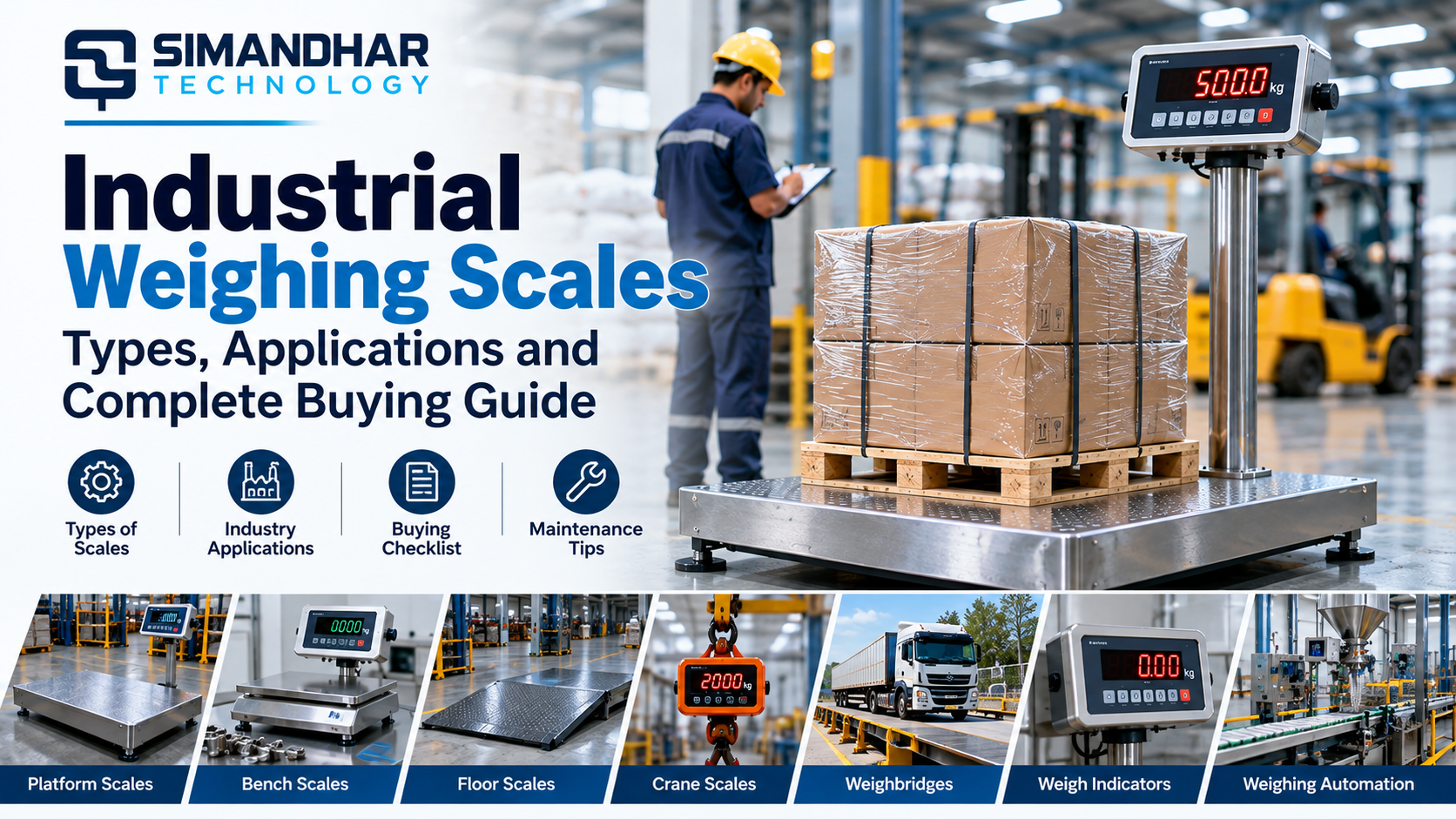
The easiest way to choose a weighing scale is to look at the work it needs to perform. Here are the main types to consider.
1. Industrial Platform Scales
An industrial platform scale is a practical choice when your team regularly weighs boxes, bags, containers, components or finished products.
For example, a manufacturing unit may use a platform scale to check the weight of outgoing goods before dispatch. A warehouse may use one to weigh cartons or containers during receiving and inventory checks.
Platform scales are available in different capacities and platform dimensions. The right combination depends on the load, the way it is placed on the scale and the measurement requirements.
Before purchasing, check:
- The maximum and minimum loads you expect to weigh.
- The dimensions and shape of the products.
- Whether goods will be placed manually or with handling equipment.
- The required readability and repeatability.
- The conditions in which the scale will operate.
A suitable platform scale should fit the actual workflow rather than force your team to change its working method unnecessarily.
2. Bench Scales for Smaller Loads
Bench scales are designed for weighing tasks that take place on a workbench, packing table or production workstation.
They are useful when employees need to weigh smaller components, packages, parts or individual products throughout the working day.
Consider a business that assembles electrical components. Employees may need to weigh parts during production or check quantities before packing. A compact bench scale can make this work easier without taking up the space required by a larger floor-mounted system.
Some bench scales also support counting functions. These can be useful when a business handles large quantities of identical small components, such as screws, nuts or washers.
When comparing bench scales, look at the smallest weight increment, the typical load, the platform dimensions and any counting or connectivity features you actually need.
3. Industrial Floor Scales
Floor scales are useful when the items being weighed are too large or heavy for a bench scale.
They may be used for drums, containers, palletised goods and other materials handled directly on the factory or warehouse floor.
Suppose a warehouse receives large containers of raw material. Moving each container to a small workstation would be inconvenient. A suitably selected floor scale placed near the receiving area may fit the process better.
The installation also deserves attention. Check the available floor space, floor condition, loading method, approach ramps and clearance around the scale.
Floor scales and platform scales can overlap in their design, so compare the actual product specifications instead of relying only on the category name.
4. Crane Scales for Suspended Loads
Sometimes the load cannot conveniently be placed on a platform. Metalworking facilities, fabrication units and other industrial operations may handle materials using cranes or hoists.
A crane scale measures a suspended load as part of a suitable lifting arrangement. This can help teams check the weight of materials while they are being moved.
When selecting a crane scale, consider the rated capacity, compatibility with the lifting equipment, display visibility and working conditions.
Safety must come first. The scale, hooks, connectors and complete lifting arrangement must be suitable for the intended load and use. Never exceed rated limits or treat a weighing instrument as a substitute for approved lifting procedures.
5. Weighbridges and Truck Scales
Businesses that receive or dispatch bulk materials may need to weigh entire vehicles.
A weighbridge, also called a truck scale, is designed for this purpose. It can support vehicle weighing at manufacturing plants, logistics facilities, agricultural operations and bulk material handling sites.
For example, a business receiving raw materials by truck may need reliable vehicle weight records to support stock reconciliation and dispatch checks.
Choosing a weighbridge involves more than selecting a maximum capacity. Buyers should consider vehicle dimensions, axle arrangements, traffic frequency, site layout, foundations, drainage, weighing software and applicable legal requirements.
If the instrument will be used for commercial transactions, confirm the relevant Indian Legal Metrology requirements before purchasing.
6. Weigh Indicators and Load-Cell Systems
A weighing indicator displays the weight measured by compatible load cells. It is an important part of many electronic weighing systems.
Depending on the model, an indicator may offer tare and zero functions, data output, printing or communication with external equipment.
Load-cell-based systems can also be incorporated into tanks, hoppers and industrial processes where materials need to be weighed at a particular stage of production.
These installations require careful planning. The load cells, mounting arrangement, supporting structure, wiring and indicator all affect the performance of the complete system.
If you need a weighing solution integrated into a machine or production line, explain the process to the supplier instead of selecting an indicator in isolation.
7. Weighing Automation Systems
Manual weighing works well for many operations. However, when a process requires repeated measurements, frequent recording or automatic control, weighing automation may be worth considering.
An automated weighing system can connect measuring equipment with controllers, software or other production equipment.
Possible applications include batching, material dosing, filling and automatic weight-data recording.
For example, a production line may need a system that measures ingredients according to a defined target. In such a case, the requirement involves more than a scale: it may include controls, software, sensors and a validated operating sequence.
Before requesting a quotation, define the process, required tolerance, data outputs, communication interfaces and what the system should do when a measurement falls outside the acceptable range.
How to Choose the Right Industrial Weighing Scale
Once you understand the available types, the next step is to match the equipment to your actual requirements.
1. Start With the Weight You Need to Measure
Write down the lightest and heaviest loads that will be weighed during normal operation.
Include containers, pallets, fixtures or other items that remain on the scale during measurement.
For example, a business weighing products in containers needs to account for the container weight as well as the product weight. The tare function may help display the net weight, but the complete load must still remain within the instrument's rated capacity.
Do not choose a scale based only on the highest available capacity. The expected operating range also affects the usefulness of the measurement.
2. Understand Accuracy, Readability and Repeatability
These three terms are often confused when comparing weighing scales.
- Readability is the smallest increment shown on the display. A scale might display weight in steps of 0.1 kg, for example.
- Accuracy describes how close a measurement is to a reference value under specified conditions.
- Repeatability describes how consistently the scale measures the same load when the measurement is repeated under comparable conditions.
A display showing more decimal places does not automatically mean the instrument is more accurate.
If your process depends on small weight differences, ask the supplier about repeatability, the usable weighing range, minimum load and relevant performance specifications.
3. Check the Platform Dimensions
The item being weighed should fit comfortably on the weighing platform and be positioned according to the manufacturer's instructions.
A platform that is too small can make loading difficult. A platform that is unnecessarily large may occupy valuable space without providing a useful benefit.
Think about the actual items your employees handle: cartons, bags, drums, pallets or irregularly shaped components.
If pallet trucks or other handling equipment are involved, explain the loading process before choosing the platform.
4. Consider Where the Scale Will Be Used
A scale operating in a clean packing area may face very different conditions from one installed in a dusty factory or a wet processing environment.
Consider dust, moisture, vibration, temperature changes, cleaning chemicals and the stability of the installation surface.
Ask for the protection rating, construction materials and operating conditions specified for the particular model. Do not assume every industrial scale is suitable for every industrial environment.
5. Decide Which Digital Features You Need
An industrial digital weighing scale may provide features beyond displaying weight.
Depending on the model, these can include:
- Tare and zero functions.
- Piece-counting functions.
- Printer connectivity.
- Computer or software interfaces.
- External displays.
- Data output for operational records.
Choose features based on the task. If employees only need to read and record weight locally, a more complicated system may not be necessary.
If your business needs weight data in inventory or production software, confirm compatibility and data formats before placing an order.
6. Check Installation and Ongoing Support
The purchase price is only one part of owning weighing equipment.
Ask how the instrument should be installed, whether the location requires special preparation and what maintenance is recommended. Also clarify warranty conditions, spare-part availability and the support offered for the selected model.
Calibration compares an instrument's performance with a reference. Adjustment changes the instrument when necessary, while verification determines whether it meets specified requirements. These are different activities, and the appropriate procedures depend on the application.
For regulated commercial weighing, check the applicable verification requirements rather than relying on a general statement about accuracy.
Industrial Weighing Scale Applications Across Different Industries
The same product category can serve different purposes depending on the business.
Manufacturing and Engineering
Manufacturing units may weigh incoming materials, components, work-in-progress products and finished goods.
Platform scales can suit heavier items, while bench scales may fit smaller components. Processes involving controlled material dosing may require an integrated weighing system.
The key is to select equipment that matches the measurement task at each stage of production.
Warehousing and Logistics
Warehouses need to keep track of goods as they arrive, move through storage and leave for dispatch.
Weighing equipment can support package checks, pallet weighing and stock records. Where measurements must be entered into a warehouse management system, data connectivity may reduce manual transcription.
Food Processing and Packaging
Food businesses may weigh ingredients, portion products and check package weights.
Cleaning procedures, moisture exposure, material compatibility and applicable hygiene requirements should guide equipment selection. A standard industrial scale should not be assumed suitable for every food-processing environment.
Pharmaceuticals and Laboratories
Some pharmaceutical and laboratory tasks require highly sensitive balances rather than general-purpose industrial scales.
The minimum sample weight, required readability, repeatability and environmental stability should determine the choice. Selecting a high-capacity scale simply because it is described as industrial may not meet the needs of a precision measurement process.
Agriculture and Bulk Materials
Agricultural businesses may weigh grains, produce, feed, fertiliser and other materials. Depending on the operation, the requirement may call for a platform scale, a farmer scale or a weighbridge.
Dust, moisture, outdoor exposure and the way materials are loaded should be considered before selecting a model.
Common Weighing Mistakes That Businesses Can Avoid
Some weighing problems come from the equipment. Others come from how it is selected, installed or used.
- Choosing the wrong capacity: A scale may be unsuitable for the actual load range even if its maximum capacity appears sufficient. Consider both typical loads and the required measurement performance.
- Ignoring the loading method: Heavy or irregular loads may be difficult to position safely. Check the platform dimensions and how goods will be moved.
- Confusing display resolution with accuracy: More decimal places do not necessarily mean better measurements. Ask for the relevant performance specifications.
- Installing the scale in an unsuitable location: Vibration, an unstable surface or environmental conditions may affect readings. Follow the manufacturer's installation requirements.
- Overlooking maintenance: Dirt, damage and changes in performance can go unnoticed without routine checks. Establish a maintenance and calibration plan appropriate to the application.
- Buying features that are not needed: Extra functionality can increase cost and complexity. Decide whether you need counting, printing, software connectivity or automation before finalising the configuration.
- Ignoring compliance: If weight measurements determine commercial transactions, check the applicable legal requirements for the instrument and its intended use.
A little planning before purchase can help prevent unnecessary changes after installation.
What Should You Ask an Industrial Weighing Scale Supplier?
Before requesting a quotation, prepare a short description of your weighing task.
Include the following information:
- What material or product will be weighed?
- What are the lightest and heaviest expected loads?
- What readability or measurement tolerance is required?
- What platform dimensions are needed?
- Will the scale operate indoors or outdoors?
- Are printing, counting or software connections required?
- Will the equipment be used for commercial transactions subject to legal requirements?
- What installation, maintenance or support arrangements are needed?
These details give the supplier a clearer picture of the application and make it easier to compare suitable configurations.
If you are comparing industrial weighing scale suppliers in Ahmedabad, Gujarat or elsewhere in India, ask for model-specific specifications and confirm availability, delivery, installation and support directly.
Explore Industrial Weighing Solutions From Simandhar Technology
Every weighing application has its own requirements. A business weighing small components may need a very different instrument from a warehouse handling pallets or a facility weighing suspended loads.
Simandhar Technology lists several weighing product categories, including industrial scales, bench scales, crane scales, weigh indicators, weighbridges and weighing automation. The available range provides a starting point for businesses exploring different weighing applications.
Before selecting a model, discuss the load, required measurement performance, operating conditions and any integration requirements with the supplier.
You can browse the Simandhar Technology product catalogue to explore the available categories. If you need help identifying a suitable option, visit the contact page to discuss your requirements.
The goal is not to buy the biggest scale or the one with the most features. It is to choose equipment that does the job your business needs, fits the way your team works and meets the relevant measurement requirements.
FAQs
1. Which industrial weighing scale is best for a manufacturing unit?
It depends on what the factory weighs. Bench scales may suit smaller components, platform or floor scales can handle larger products, crane scales measure suspended loads, and weighing automation may support controlled production processes.
2. How do I select the correct capacity for an industrial weighing scale?
Identify the lightest and heaviest loads, including containers or fixtures. Consider the expected operating range, load distribution and measurement requirements. Confirm the suitable capacity and operating limits with the supplier.
3. What is the difference between an industrial platform scale and a bench scale?
Platform scales generally accommodate larger items and heavier loads, while bench scales are designed for smaller loads at workstations or packing tables. The actual distinction depends on each model's capacity, dimensions and specifications.
4. Are industrial digital weighing scales suitable for warehouse inventory management?
They can be. Depending on the model, a digital scale may support routine weight checks, tare functions, printing or data connectivity. If you need automatic inventory updates, confirm that the scale and software can communicate as required.
5. How often should an industrial weighing scale be calibrated?
There is no single interval that suits every application. The schedule depends on usage, operating conditions, measurement risk, quality procedures and applicable regulations. Follow the manufacturer's guidance and relevant requirements.
6. Can one weighing scale be used for every industrial application?
Usually, one scale should not be assumed suitable for every task. Heavy loads, small samples, suspended materials and automated processes have different requirements. Compare capacity, readability, installation, environment and intended use before selecting equipment.
7. Where can I find industrial weighing scales in Ahmedabad, Gujarat?
You can explore the weighing product categories listed on the Simandhar Technology website and contact the company to discuss your application. Confirm the availability, specifications and support arrangements for the model you need before purchasing.
Conclusion
Choosing an industrial weighing scale starts with a simple question: what exactly does your business need to weigh?
Once you know the load, measurement requirements, operating conditions and workflow, it becomes easier to compare suitable equipment. Look beyond the displayed capacity and purchase price. Platform dimensions, repeatability, connectivity, installation and compliance can all influence whether a scale is right for your operation.
If you are planning to purchase weighing equipment, prepare your requirements first and discuss them with a supplier. That is a more reliable way to find a weighing solution that fits your business than choosing a model based on specifications alone.